What am I about to invest in?
WeVèz opens its capital increase campaign aimed at Financing Members, with the goal of replicating its pilot model of the San Lazzaro di Savena Energy Community in new territories to be activated in the energy transition.
WeVèz intends to raise up to 300,000 euros through the issuance of Financing Member Shares, in order to complete the launch of the Renewable Energy Community of San Lazzaro di Savena and develop new energy configurations.
Coopfond's Support
WeVèz's campaign is backed by an excellent partner: Coopfond, Legacoop's mutual fund, created to promote and develop cooperation in Italy and a reference point for the country's sustainable economy. With this initiative, Coopfond confirms its trust in the project and its ability to generate economic, social, and environmental value, committing to double every euro invested by the community on Ener2Crowd through a unique matchfunding mechanism.
Concretely, Coopfond will proceed with the subscription of Participatory Financial Instruments (SFP), for a maximum amount of 150,000 euros, investing outside the platform.
This means that every investment made by Ener2Crowd users will have an immediate and multiplied impact, thanks to the contribution of a solid and long-standing institutional fund.
The involvement of Coopfond represents concrete recognition of WeVèz's seriousness, vision, and potential, and a strong signal for all investors who want to participate in a high-impact cooperative project, supported by one of the most authoritative protagonists of Italian ethical and mutual finance.
The Project
WeVèz is a Renewable Energy Community (REC) that allows citizens, companies, and local authorities to share and consume energy produced from renewable sources. It was one of the entities winners of the Emilia-Romagna Regional Call for Applications for the development of RECs and is among the first in Italy to have completed the reporting of a technical-economic feasibility study in 2024.
The San Lazzaro project represents the first step of the WeVèz model: a pilot configuration that will allow us to demonstrate the technical, economic, and social sustainability of our Energy Community. The capital raising through this crowdfunding campaign is aimed at creating the economic and operational foundation to replicate the model in other Municipalities, accelerating the spread of new RECs in the territory.
WeVèz's mission is to make energy more democratic, sustainable, and local, promoting social inclusion and technological innovation. With a cooperative and mutualistic approach, the goal is to facilitate the energy transition, reduce CO₂ emissions, and generate economic and environmental benefits for all members. The project is thus part of a strategic context where the energy transition represents not only an environmental objective but also an opportunity to build more resilient and energy-independent communities.
Who are the members of an REC
Within the REC, we distinguish three operational roles. The consumer uses shared energy without producing it; the prosumer uses it and can also feed the energy they produce into the grid; the final customer benefits from the cooperative's services without entering a specific REC configuration. These positions define how services are accessed and how the benefits of energy sharing are obtained according to the internal regulations.
Technology and services
The photovoltaic system will be built with over
1,500 latest-generation panels, designed to ensure maximum efficiency and durability over time. The direct connection to the San Lazzaro primary substation will ensure efficiency and stability in the distribution of the produced energy, minimizing dispersion and enhancing every kilowatt-hour generated.
The energy obtained will not remain a mere technical datum, but will be concretely shared and redistributed among families, shops, and businesses in the area, allowing community members to benefit from reduced bill costs and access the state incentives dedicated to Renewable Energy Communities.
In this way, technology becomes the tool through which WeVèz translates innovation and sustainability into a tangible economic advantage and greater autonomy for the local community.
Reduction of energy costs
The economic solidity of the project is guaranteed by a combination of revenue sources that ensure its long-term sustainability. In addition to the incentives provided by the GSE for Renewable Energy Communities, the San Lazzaro community will benefit from the direct reduction of energy costs on bills for families and businesses, as well as active agreements with energy partners that further strengthen the model's financial stability. This structure allows for the generation of recurring and predictable revenues, capable of resisting even the natural volatility of the energy market and offering participants a stable and lasting return horizon. Looking ahead, the aggregation of new members and the possibility of replicating the model in other local contexts will further contribute to expanding the economic base and consolidating WeVèz's growth in the medium-to-long term.
Social dimension and cash-back
San Lazzaro is not just a photovoltaic plant, but a true
social laboratory capable of generating value for the entire community. The project strengthens the bond between citizens, businesses, and public bodies, creating a more cohesive and participatory social fabric.
Through the redistribution of economic and energy benefits, it helps to combat energy poverty, making the advantages of the green transition accessible even to the most vulnerable segments of the population.
Through a cash-back mechanism, the realized incentive can be made available to local activities. At the same time, by retaining wealth and value in the territory, the energy community produces a positive impact from both an environmental and social perspective, demonstrating how sustainability can translate into shared and inclusive growth. Furthermore, the initiative stimulates a sense of belonging and collective responsibility, promotes more conscious consumption practices, and creates new opportunities for collaboration between citizens and institutions.
The model to replicate
The WeVèz Energy Community pilot project is the realization of the configuration of San Lazzaro di Savena (Bologna), which will host the first 1 MWp photovoltaic plant, currently under construction and with inauguration expected by the end of 2025. This plant, owned by the Energy Community, thanks to its power and the advanced technology with which it is being built, will be able to produce approximately 1,500,000 kWh per year, an amount of energy sufficient to cover the annual consumption of about 500 families, 25 commercial establishments, and 10 local companies.
In this way, San Lazzaro will become a true benchmark for the production and sharing of renewable energy at the local level, serving as a pilot model capable of inspiring other communities and territories.
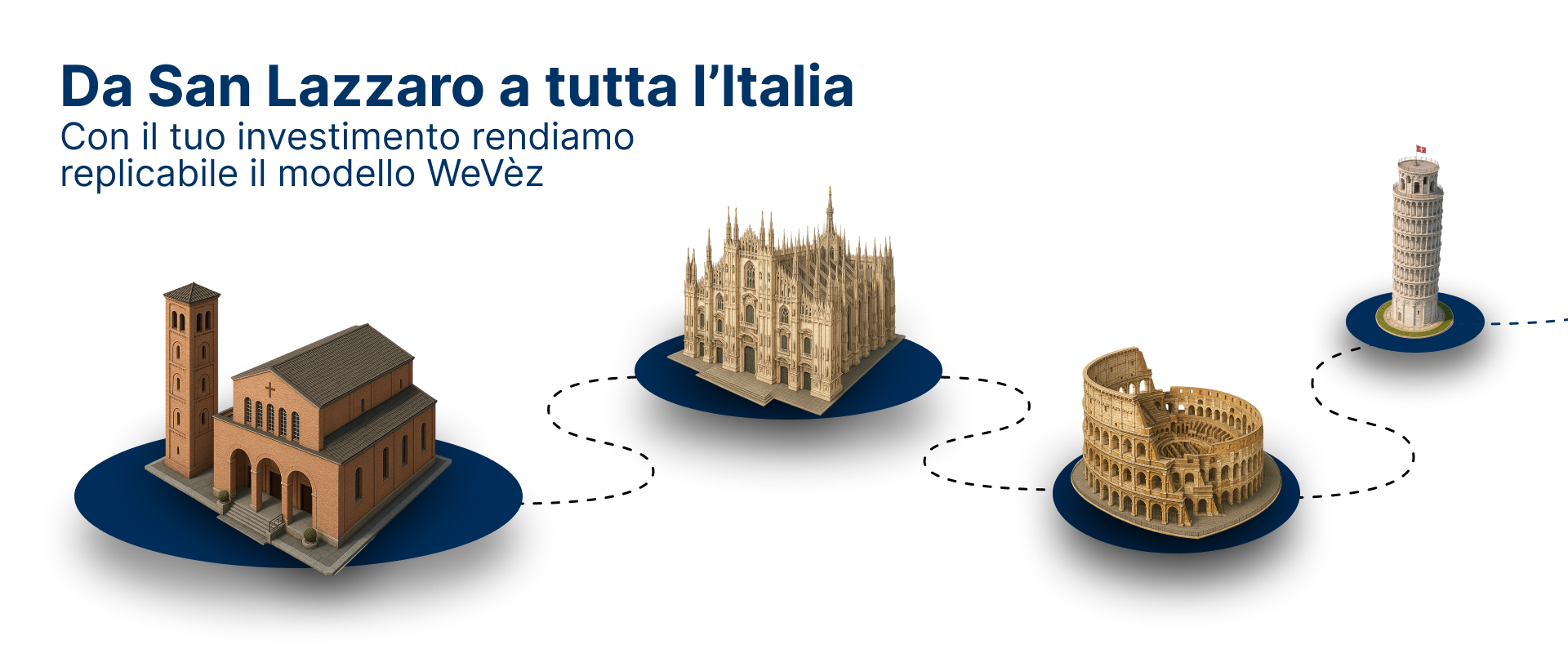
This first plant is the prototype of a replicable model: thanks to the crowdfunding campaign, WeVèz will have the necessary resources to extend its network of Energy Communities in neighboring Municipalities and other Italian territories, making the energy transition a collective and scalable project.
The environmental impact of the project is equally significant: the plant's production will allow for the avoidance of approximately 750 tonnes of CO₂ emissions per year, a result that is equivalent to the absorption capacity of over 35,000 planted trees. These figures immediately convey the extent of the benefit that the WeVèz project brings to the territory and the planet, combining energy development, sustainability, and community well-being. The initiative will also have positive effects on an educational and cultural level, strengthening public awareness of the importance of the green transition.
The favorable regulatory environment
The regulatory context represents a further element of stability. Renewable Energy Communities are supported by national incentives managed by the GSE and by fEuropean funds like the PNRR and the FESR, instruments that guarantee concrete and long-term economic support for those who invest in projects of this type. Alignment with the European objectives for climate neutrality by 2030 and the European Green Deal reinforces the project's consistency with current energy and environmental policies.
The regulatory framework for Renewable Energy Communities is now defined and coherent at the European and national levels. The RED II Directive, transposed in Italy with art. 42-bis of Legislative Decree 162/2019 and with Legislative Decree 199/2021, was completed by the DM CER 414/2023 and the GSE Technical and Operational Rules, which clarify requirements, authorization procedures and access to incentives for shared energy. This body of rules provides legal certainty to the initiatives and allows for multi-year planning for the development of new configurations.
ARERA, with resolutions 318/2020 and 727/2022 (TIAD), has regulated the measurement, valuation, and distribution of widespread self-consumption, establishing uniform criteria for the calculation of economic benefits disbursed by the GSE. The standardization of technical-economic parameters facilitates the setting up of comparable and scalable project models, reducing operational uncertainty throughout the configuration lifecycle.
The legislation allows for the activation of CERs and CACERs on the existing grid and operation within the perimeter of the primary substation, favoring modular dissemination across multiple territories. The San Lazzaro case, defined in the relevant master plan with the substation perimeter and proximity analysis, represents a replicable pilot following the same technical and administrative logic.
Uniqueness of the project
San Lazzaro represents WeVèz's replicable model: a concrete example of how communities can become protagonists of the energy transition. By investing in the San Lazzaro pilot project, investors will make replication possible across multiple territories: resources will be freed up and dedicated to the authorization activities necessary for the construction of new renewable energy plants.
WeVèz thus positions itself as a pioneer in Italy in the development of RECs, with the ambition to spread this approach to other territories. Its uniqueness lies in the ability to combine technological innovation, environmental impact, and social inclusion in a single integrated strategy, offering not only a sustainable investment but also an approach that puts people and the territory at the center. This distinctive approach allows WeVèz to present itself as an entity capable of driving change and creating a network of energy communities that, starting from San Lazzaro, can progressively spread at the regional and national levels.
The Project Owner
WeVèz is a share-based cooperative society located in Bologna, established with the goal of developing and managing Renewable Energy Communities across Italian territory. Its cooperative nature reflects its core mission: to put people and local communities at the center, ensuring an inclusive, democratic, and participatory model. Every member can contribute to the project not only as a beneficiary of economic and energy advantages but also as an active part in the governance and development of the initiatives.
The company was recognized and awarded in 2024 as one of the first RECs in Emilia-Romagna to complete the technical-economic feasibility study required by the regional call for applications, distinguishing itself for organizational solidity and vision.
Adherence to the national and European regulatory framework on renewable energy guarantees WeVèz a secure and consistent positioning with long-term sustainability strategies.
THE OPERATIONAL TEAM
The team leading WeVèz is composed of the two founders Paolo Benfenati and Matteo Fini, who are supported by individuals with complementary experience in the renewable energy, administrative and financial management, and social cooperation sectors.
Paolo Benfenati boasts over thirty years of experience in the information technology, energy efficiency, and start-up sectors. He has worked in multinational environments and brings advanced skills in big data, cloud computing, business intelligence, and artificial intelligence. His mission is to put this wealth of knowledge at the service of young people, the community, and the environment, contributing to building a more sustainable and inclusive future.
Matteo Fini, a graduate in mechanical engineering, developed a professional career that led him to cover roles of increasing responsibility until becoming Director of Operations in a mechanical engineering multinational. After managing complex plants in various countries, he decided to dedicate himself to environmental issues and renewable energy, driven also by his collaboration with Paolo and the desire to make his skills available to the community.
In summary, WeVèz presents itself as a solid, innovative, and locally rooted entity, capable of combining environmental sustainability, social inclusion, and economic returns. The cooperative embodies a new energy business paradigm: no longer focused exclusively on profit, but oriented towards generating widespread and lasting value for the communities that are part of it.
The Business Plan
The WeVèz business plan was created with the goal of transforming San Lazzaro di Savena into a reference model for local and national energy transition. The 1 MWp photovoltaic plant, currently under construction, represents only the first step in a broader development strategy.
To finance the subsequent realizations following the launch of the San Lazzaro di Savena Energy Community, WeVèz has launched an equity crowdfunding campaign that involves increasing the share capital through the entry of new financing members. The operation was approved by the Board of Directors and is taking place in parallel with the investment by Coopfond, which participates as an institutional investor by subscribing to participatory financial instruments. This choice further strengthens the solidity of the initiative and demonstrates the trust of a nationally important partner in the project.
The capital raised will be used to free up the resources currently employed in the construction of the 1 MWp photovoltaic plant in San Lazzaro di Savena and to cover the expenses connected to the commissioning of the community, so that they can be allocated to support the business plan and the dissemination of new Energy Community configurations. Each financing share has a nominal value of €500 and is reserved for financing members.
UP TO 2025
The WeVèz business plan is based on a solid and realistic economic-financial projection, derived from revenues from the production and sharing of renewable energy, GSE incentives, and agreements stipulated with energy partners.
In the 2025 financial year, revenues showed a decrease compared to what was planned, attributable to the delay in the launch of the San Lazzaro di Savena photovoltaic plant, the postponement of revenues from consulting and community engagement, and the deferred start of some contracts scheduled for the final part of the year. These are mainly calendar effects: the value is expected to be received in subsequent periods, with greater visibility on the quality of the flows.
Meanwhile, operational management remained disciplined: direct and administrative costs under control, expenses monitored, and overall economic sustainability preserved. Profitability is compressed due to lower volumes, a physiological dynamic in a phase where assets are being built and the energy community's operation is being prepared.
The capital structure remains solid and consistent with the prospects of the business plan, with adequate coverage to support investments and the launch of new REC configurations. The pipeline is in execution, and San Lazzaro di Savena represents the operational reference point on which to graft further developments, also as a replicable model.
Supporting this path is an external validation: a non-repayable grant of €150,000 granted by the Emilia-Romagna Region for the San Lazzaro di Savena plant, which confirms the technical and industrial credibility of the project.
The focus remains on the completion of assets and the progressive activation of flows: we expect a gradual improvement with the entry into operation of the plants and the strengthening of service lines, maintaining a prudent but growth-oriented approach.
From 2026 to 2029
From 2026, a phase of orderly and scalable execution opens up for WeVèz. With the close of the 2025 financial year and the realization of the San Lazzaro di Savena photovoltaic plant, together with the related community engagement, the start-up phase concludes, to which the Directors have contributed directly with operational mandates. In these years, the organizational, technical, and community model of the Cooperative have been built: development activities, design, institutional relations, and territorial promotion that have been largely capitalized because they constitute a strategic intangible asset destined to generate value in the medium term. This wealth of skills, tools, and relationships is the "replicable core" of the WeVèz model to be extended to new contexts for the activation of further Renewable Energy Communities (RECs).
In terms of investments, the new Business Plan does not currently foresee the direct construction of further plants owned by the Cooperative. The priority is to concentrate resources on the development of new photovoltaic plants to be transferred to dedicated special purpose vehicles for construction and management. In the presence of adequate financial resources, WeVèz may acquire minority stakes in these vehicles, accompanying third-party investors in the execution and making the produced energy available to the Cooperative and its connected RECs.
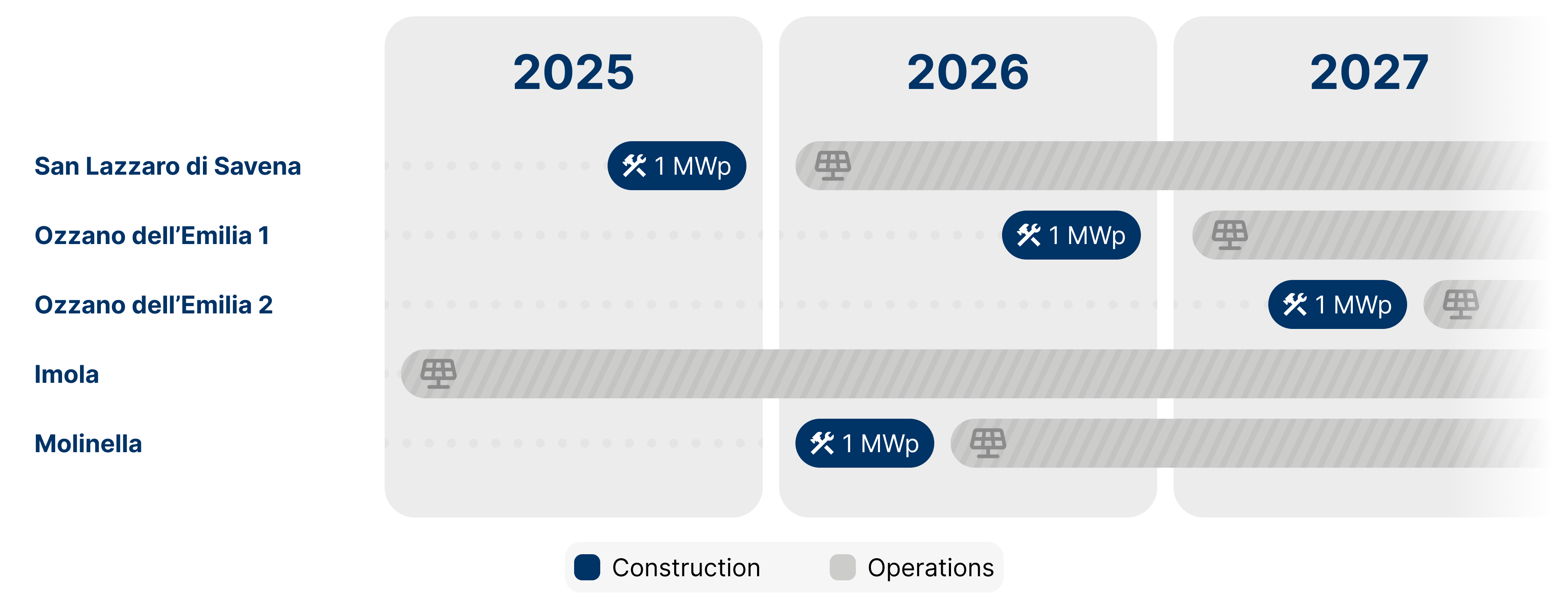
The goal is to reach an aggregated installed capacity of approximately 5 MW within the two-year period 2027–2028: 2 MW already present (Imola and San Lazzaro di Savena), 2 MW in the pipeline (Molinella and Ozzano Emilia 1), and an additional 1 MW during 2026 (Ozzano Emilia 2).
The economic trajectory reflects the progressive commissioning of the REC configurations and the maturation of revenues related to shared energy, community engagement activities, and public funds for the energy transition. The consulting activities foreseen in the initial phase will give way to continuous services to the established communities, according to a model of recurring and scalable revenues, aligned with the mutualistic mission.
The 2026–2029 strategic lines are twofold: consolidate and efficiently manage the active RECs, with the goal of reaching five operational configurations by 2029; extend the WeVèz model to other areas of Emilia-Romagna and neighboring regions, leveraging partnerships with local authorities and territorial cooperatives.
In summary, from 2026, WeVèz moves from a construction phase to a phase of consolidation and disciplined growth: the San Lazzaro di Savena asset and the ongoing pipeline provide concrete bases for expanding the number of active configurations, progressively increasing recurring flows, and strengthening the Cooperative's capacity to support the energy transition in the territories.
CATEGORIES OF SHARES
General StructureThe Financing Member Shares issued by the Cooperative are registered, indivisible, and transferable exclusively within the limits and conditions provided by the Bylaws and Regulations, subject to the necessary prior approval of the Board of Directors. Each share has a nominal value equal to €500.00 (five hundred/00) and represents a share of the capital reserved for investors joining the Cooperative, as Financing Members, pursuant to art. 2526 of the Civil Code.The newly issued shares are intended to strengthen the capital structure of the Cooperative for the development of renewable energy production and sharing projects, also through the activation of CACER and REC configurations, in compliance with the applicable legislation, Legislative Decree 199/2021 and Ministerial Decree 414/2023 (the so-called "DM CER"). The investment has a minimum duration of 60 (sixty) months, after which the Financing Member may exercise the right of withdrawal ad nutum, at the nominal value of the subscribed shares, by giving written notice to the Cooperative in the terms and manner indicated in the Regulations.
The distribution of guaranteed minimum dividends, in the presence of profits, occurs within 60 days of the approval of the financial statements; if the operating profit does not allow for full payment, the residual quota is deferred and recoverable in subsequent financial years, within the 60-month participation term, within the limits of distributable profits.
In the event of the dissolution of the Cooperative, the Financing Member Shares enjoy precedence in the reimbursement of share capital over ordinary shares, subject to subordination to operating losses and the rules on prevailing mutuality.
All Financing Members, regardless of their category, are entitled to:
- the co-sale right (tag along) in the event of the transfer of the majority of the Financing Members' shares;
- the right to participate, within the limits provided by the Bylaws, in assembly resolutions affecting their patrimonial and administrative rights;
- the further prerogatives provided for by art. 15 et seq. of the Bylaws and the Regulations.
It is specified that all investments are subject to a condition precedent of acceptance of the application for admission as a financing member of the cooperative and, for this reason, the release of capital will only occur following the resolution of the Project Owner's Board of Directors.
Category A – investors with economic and administrative rights
Category A is intended for investors – natural or legal persons – who subscribe to a total amount not less than €15,000.00 (equal to no. 30 shares).
These shares confer a minimum dividend of 4% (four percent) annually on the nominal value, payable in the presence of distributable profits.
Category A shares grant voting rights in the assembly, at the rate of one vote per share subscribed, provided that the total votes expressible by the Financing Members cannot exceed one-third of the total votes of the assembly.
Should this threshold be exceeded, the votes of the Financing Members will be automatically reduced proportionally, by applying the corrective coefficient provided for by the Bylaws.
Category A shareholders are also entitled to:
- the right to nominate one (1) director of the Cooperative;
- the right to nominate one (1) statutory auditor and one (1) alternate auditor, or, in the absence of a Board of Statutory Auditors, one (1) independent auditor;
- the right to nominate one (1) liquidator in the event of the dissolution of the Cooperative.
The additional prerogatives of withdrawal, precedence, subordination, and co-sale common to all categories remain unchanged.
Category B – non-voting investors (legal persons)
Category B is reserved for legal persons who subscribe to an amount less than €15,000.00 (equal to a minimum of no. 10 shares, for a total value of €5,000.00).
Shares in this category do not confer voting rights, but guarantee a minimum dividend equal to 5% (five percent) annually, payable in the presence of profits.
Category B Financing Members enjoy all common protections, including the right of precedence in liquidation, subordination to losses, the right of withdrawal *ad nutum* after 60 months, and the tag along clause in case of transfer of the majority.
Category C – non-voting investors (natural persons)
Category C is reserved for natural persons who subscribe to an amount less than €15,000.00 (equal to a minimum of no. 3 shares, for a total value of €1,500.00). In this case too, the shares do not grant voting rights, but recognize a minimum dividend equal to 6% (six percent) annually in the presence of profits.
Category C Financing Members fully participate in the economic benefits of the Cooperative, enjoying the same protections recognized to the other Financing Members: precedence in the reimbursement of capital, subordination to losses, right of withdrawal after 60 months, and co-sale right (*tag along*).
Exit Strategy
WeVèz has provided specific exit instruments aimed at guaranteeing the liquidity of the investment and the protection of the investor in the medium term. The main methods of divestment are represented by:
a) Withdrawal *ad nutum* after the minimum term of 60 months
After the minimum holding period of **60 (sixty) months** from the date of registration in the Register of Members, the Financing Member has the right to freely withdraw (*ad nutum*) from the Cooperative, by sending written communication with at least 60 days' notice.
Reimbursement occurs **at the nominal value of the subscribed shares (€500.00 each)**, increased by accrued and unpaid dividends, within 90 days of the approval of the financial statements for the year in which the withdrawal was exercised.
The right of withdrawal is guaranteed by art. 2526 of the Civil Code and regulated by articles 15 et seq. of the Bylaws, which provide for the allocation of contributions from Financing Members to a specific section of the net assets, intended to ensure the separation and traceability of financial flows related to these shares.
The 60-month withdrawal represents the form of *natural exit* consistent with the mutualistic structure of the Cooperative, guaranteeing the financing member the recovery of nominal capital and accrued dividends, without depending on a secondary market or speculative valuations.
b) Co-sale Clause (*Tag Along*)
In the event of the transfer or sale of the majority of the Financing Member Shares, each member, regardless of the category of belonging, has the right to adhere to the operation and to sell their stake under the same economic and contractual conditions recognized to the referring selling member.
This clause, regulated in the Regulations, allows subscribers to benefit from any extraordinary capitalization operations of the Cooperative, in coherence with the regulations on cooperative capital and mutualistic principles.
Projection of return based on 60-month withdrawal for Category C investors
For purely illustrative purposes, an economic-financial projection of the expected return for an investor in **Category C Shares** (natural persons) is proposed, based on the parameters established by the assembly resolution:
- **Nominal value per share:** €500.00
- **Minimum number of shares subscribed:** n. 3
- **Capital invested:** €1,500.00
- **Investment duration:** 60 months (5 years)
- **Guaranteed minimum dividend in the presence of profits:** 6% annually
Assuming the disbursement of the minimum dividend of 6% annually on the nominal value for the entire duration of the period (in the presence of profits), and the full reimbursement of the nominal capital at the end of 60 months, the total return would be as follows:
| Year |
Capital Invested (€) |
Annual Dividend (€) |
Cumulative Dividends (€) |
Final Reimbursement Value (€) |
Total Value (€) |
| 1 | 1,500.00 | 90.00 | 90.00 | - | 1,590.00 |
| 2 | 1,500.00 | 90.00 | 180.00 | - | 1,680.00 |
| 3 | 1,500.00 | 90.00 | 270.00 | - | 1,770.00 |
| 4 | 1,500.00 | 90.00 | 360.00 | - | 1,860.00 |
| 5 | 1,500.00 | 90.00 | 450.00 | 1,500.00 | 1,950.00 |
Gross Total Return (5 years): €450.00 on €1,500.00 = +30.00%
This return is to be considered prudent, as it is based only on the minimum dividend provided. Any higher profits, extraordinary distributions, or capital valuations deriving from co-sale operations (*tag along*) could lead to an increase in the effective return.
Environmental Benefits
The San Lazzaro configuration allows for the replacement of portions of fossil fuel energy with local renewable production. The 1 MWp plant is sized to generate approximately 1.5 GWh/year, with an estimated reduction of 750 tonnes of CO₂/year, equivalent to the absorption capacity of over 35,000 trees. These results, already measurable at the pilot plant level, represent the quantitative basis to be replicated in subsequent configurations.
The local production and sharing of energy reduce grid losses and improve the overall efficiency of the electrical system, helping to contain indirect emissions throughout the supply chain. The integration of monitoring and smart metering systems also enables more conscious consumption behaviors, flatter peaks, and more elastic demand, with positive effects on both emissions and grid stability in the medium term.
On a territorial scale, the REC promotes better air quality (absence of on-site combustion and lower local emissions), incentivizes the efficient use of resources (self-production and shared self-consumption), and supports urban resilience by reducing external energy dependence. The perimeter logic of the primary substation makes these advantages scalable: the extension of the model to new municipalities replicates the same technical-administrative scheme, multiplying the environmental benefits generated by the pilot.
Alignment with the SDGs
- SDG 7 – Affordable and Clean Energy: shared renewable generation and reduction of energy bills.
- SDG 9 – Industry, Innovation, and Infrastructure: digitized energy infrastructure and integration of smart metering technologies.
- SDG 11 – Sustainable Cities and Communities: local and community production that strengthens the resilience and well-being of the territories.
- SDG 12 – Responsible Consumption and Production: optimization of load profiles and efficient use of energy through data and awareness.
- SDG 13 – Climate Action: measurable reduction of greenhouse gas emissions through the replacement of fossil generation.
This approach makes it possible to associate clear environmental indicators (renewable energy produced, CO₂ avoided, improved efficiency) with every new configuration and to consolidate a credible path of territorial decarbonization starting from the San Lazzaro pilot.
